
Anyone searching for information on Faston Crypto Etherions has probably noticed something strange: no two explanations quite line up. Some sources call it a gaming platform, others describe it as a DeFi protocol, and a few present it as a hybrid blockchain built for speed. That inconsistency isn’t an accident of bad writing. It reflects how little verified information actually exists about the project, even as search interest around the name keeps growing.
This article lays out what Faston Crypto Etherions claims to be, how its pieces supposedly fit together, and — just as importantly — what a careful reader should question before treating any of it as established fact.
What Is Faston Crypto Etherions?
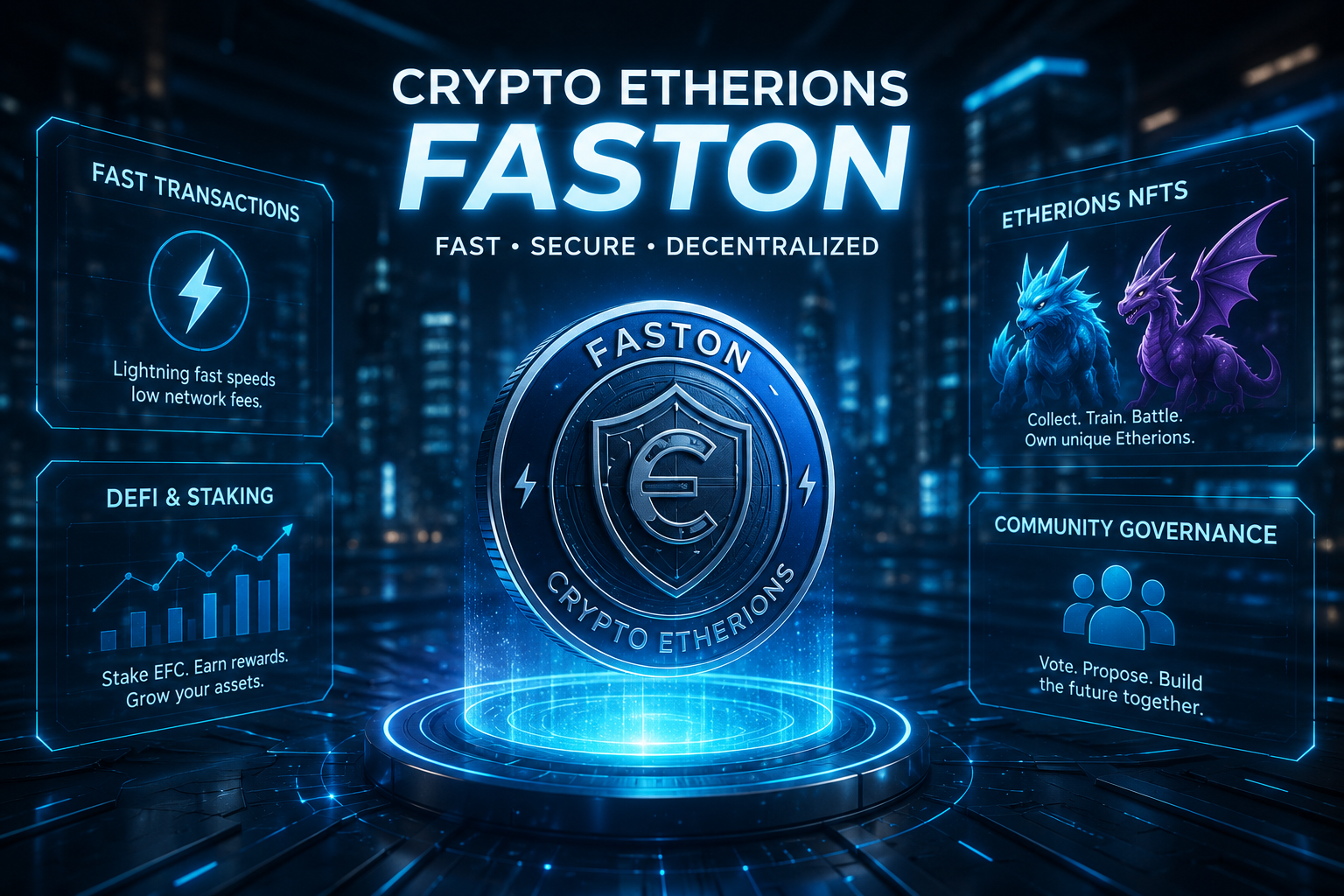
At its most basic, Faston Crypto Etherions is described as a blockchain-based ecosystem built around three ideas stitched together: a native token, a collection of tradable NFT creatures, and a layer of decentralized finance features like staking and governance. The native token typically goes by the shorthand EFC.
The pitch is that Faston Crypto Etherions isn’t just another speculative coin. It’s positioned as infrastructure — a chain designed to process transactions quickly and cheaply — combined with a game economy where digital creatures called Etherions can be owned, traded, trained, and battled as NFTs.
That’s the marketing summary, at least. Whether it holds up as a functioning, audited, widely used product is a separate question, and one that’s genuinely difficult to answer from publicly available material.
Where the Name Comes From
The name itself is doing a lot of work. “Faston” is presented as the protocol layer, the technical backbone said to host smart contracts and process transactions. “Etherions” refers to the digital creatures living inside the project’s game economy. And the inclusion of “Ether” is clearly meant to draw a mental line to Ethereum, borrowing some of its credibility by association.
That’s worth pausing on. Sounding adjacent to an established network isn’t the same as being built, audited, or verified in the way Ethereum itself has been. Plenty of projects in the crypto space lean on naming conventions that suggest legitimacy or technical pedigree without independent proof to back it up. Faston Crypto Etherions sits in that same gray area — the name signals a lot, but signaling isn’t verification.
The Three Layers of the Ecosystem
Most descriptions of Faston Crypto Etherions break it into three functional layers. The first is the blockchain or protocol layer itself, said to run on modified, EVM-compatible architecture. This would, in theory, let developers migrate existing Ethereum-based tools and smart contracts without extensive rewrites.
The second layer is the NFT gaming component, built around the Etherions creatures. The third is a DeFi layer, offering staking, governance participation, and other token-based utilities familiar to anyone who has used similar platforms before.
On paper, that’s a reasonable structure — plenty of successful projects combine infrastructure, collectibles, and finance. The open question with Faston Crypto Etherions is how much of this is live, functioning software versus a roadmap or marketing description that hasn’t yet been independently confirmed.
How the Etherions NFTs Work
The Etherions themselves are described as unique digital creatures, each one an individual NFT with its own traits. Users are said to be able to create, buy, sell, train, and battle them, with comparisons frequently drawn to earlier NFT-based games like CryptoKitties or Axie Infinity, or more casually to a blockchain version of Pokémon.
The appeal is straightforward enough. Digital ownership tied to gameplay has proven popular before, and a system where creatures have measurable, tradable value gives collectors and gamers overlapping reasons to participate. If Faston Crypto Etherions delivers a functioning version of this loop, it fits neatly into a genre of crypto-gaming that already has an established, if inconsistent, track record.
The catch is that “unique NFT creature you can battle” is also one of the easiest concepts to describe convincingly without a working product behind it. Screenshots, mockups, and roadmap language can all exist well before — or entirely without — a functioning game.
The Role of the EFC Token
EFC is described as the currency that ties the whole system together. It’s said to function as a gas token for network transactions, a staking asset, a governance tool for voting on protocol decisions, and the in-game currency used to acquire or interact with Etherions.
That kind of multi-purpose design is common in modern token economics — a single asset covering utility, governance, and in-game spending simplifies the user experience, at least in theory. But multi-use tokens also depend heavily on genuine demand across all of those functions. A token that’s supposed to power gas fees, staking rewards, governance, and in-game purchases only works if each of those systems actually exists and attracts real usage, not just written descriptions of intended usage.
Specific figures around EFC’s supply, circulation, and distribution vary noticeably depending on the source. Some materials describe fixed token caps and circulating percentages; others don’t mention numbers at all. That inconsistency is itself a signal — reliable token economics are usually documented in one consistent place, not reconstructed differently across secondary sources.
Speed and Technology Claims
A recurring theme across descriptions of Faston Crypto Etherions is speed. The project is frequently said to process transactions within seconds, at a fraction of the cost associated with congested networks, using a hybrid consensus mechanism that blends proof-of-stake and proof-of-work elements.
Fast, cheap transactions are a genuinely valuable feature in blockchain gaming specifically, since frequent small transactions — buying items, training creatures, initiating battles — become impractical if fees are high or confirmations are slow. If Faston Crypto Etherions has actually built infrastructure that solves this, it addresses a real and well-documented pain point.
That said, technical performance claims in crypto are notoriously easy to state and hard to verify without independent benchmarking, public testnets, or third-party audits. “Processes transactions in seconds with fees under a cent” is the kind of claim nearly every new chain makes at launch. Whether Faston Crypto Etherions has demonstrated this under real network load, rather than describing it as an intended capability, isn’t something that can be confirmed from marketing copy alone.
Why the Details Are Hard to Verify
This is probably the most important section for anyone trying to understand Faston Crypto Etherions seriously. Descriptions of the project across different sources genuinely don’t agree with each other. Supply figures differ. Consensus mechanism details differ. Even basic characterizations — is it primarily a gaming platform, a DeFi protocol, or a general-purpose chain — shift from one write-up to the next.
That kind of inconsistency doesn’t automatically mean a project is fraudulent, but it’s a meaningful red flag. Established, credible crypto projects typically have a single authoritative source of truth: an official whitepaper, a verifiable smart contract address, an audit report from a recognized firm, and a consistent public roadmap. When secondary sources describing Faston Crypto Etherions can’t agree on foundational details, it suggests that authoritative source either doesn’t exist publicly, isn’t easy to find, or hasn’t been consistently maintained.
How It Compares to Similar Projects
Positioned against the broader landscape, Faston Crypto Etherions resembles a category of projects that combine speed-focused blockchain infrastructure with NFT gaming — a formula that became popular during the play-to-earn boom. Some projects in that category matured into genuinely used platforms with active communities and measurable transaction volume. Others launched with similar language, generated a burst of search interest, and then faded without ever reaching functional maturity.
Without independently verifiable usage data — things like on-chain transaction counts, wallet activity, exchange listings with real liquidity, or audited smart contracts — it’s genuinely difficult to say which category Faston Crypto Etherions falls into. The language used to describe it is consistent with both possibilities.
Risks Worth Understanding
Anyone considering engagement with Faston Crypto Etherions, whether as a potential investor, gamer, or collector, should treat the unresolved questions above as central rather than incidental. A project whose supply figures, consensus design, and core identity shift between sources hasn’t necessarily done anything wrong — but it also hasn’t given outside observers the tools to confirm its claims.
Standard crypto risks apply here as they would to any emerging project: token value can be highly volatile, NFT assets can lose liquidity quickly if interest fades, and projects without independent security audits carry elevated smart contract risk. None of this is unique to Faston Crypto Etherions, but the lack of consistent public documentation makes it harder than usual to assess how much of that risk applies.
What to Check Before Getting Involved
Before treating any claim about Faston Crypto Etherions as settled, it’s worth looking for a few concrete things. An official whitepaper hosted on a verifiable, consistent domain. A published, checkable smart contract address on a block explorer. Evidence of a third-party security audit from a recognized firm. Real trading volume on exchanges with genuine liquidity, rather than listings that exist but see little activity.
If those elements are easy to find and consistent with each other, that’s a meaningful sign the project has more substance behind it than marketing language alone. If they’re absent, contradictory, or hard to locate, that gap is worth weighing carefully before committing money, time, or personal data to the platform.
Final Thoughts
Faston Crypto Etherions presents an ambitious pitch: fast, low-cost blockchain infrastructure combined with collectible NFT creatures and DeFi utility, all tied together by a single token. That combination isn’t implausible — similar structures have worked for other projects in the past. What sets Faston Crypto Etherions apart right now isn’t the concept itself but the inconsistency surrounding its documentation.
Readers encountering the name for the first time are better served by treating current descriptions as claims to be verified rather than facts already established. Given how much the available information varies from one source to the next, doing that independent verification — checking contracts, audits, and real usage data — matters more here than in cases where a project’s fundamentals are already a matter of public record.
This article is for general informational purposes only and isn’t financial or investment advice. Crypto assets carry significant risk, and anyone considering involvement with Faston Crypto Etherions should do their own independent research before making financial decisions.
Read more trending Blogs on zio magazine.