
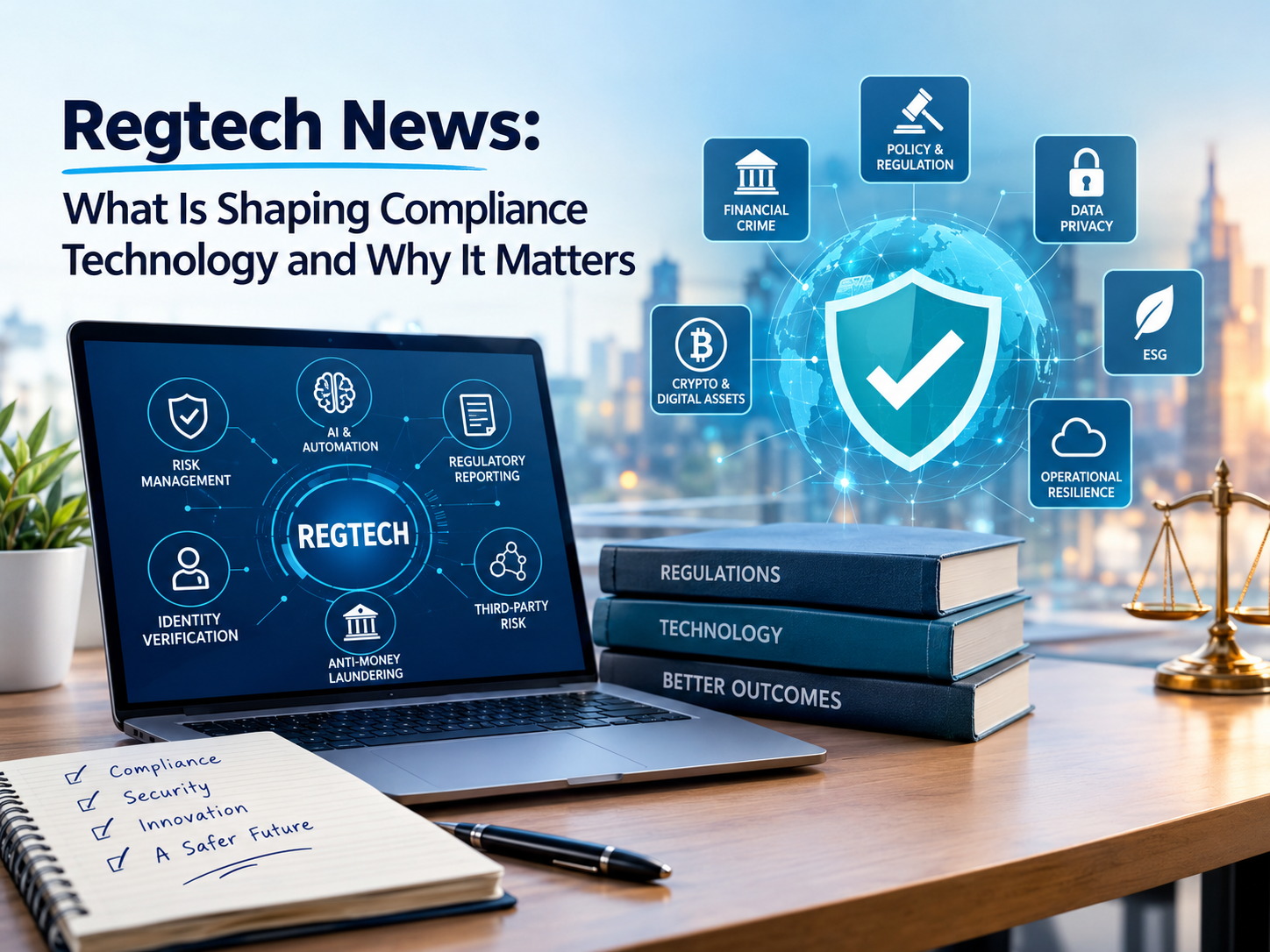
Every few months, a new rule lands on the desk of a compliance team, and every few months, a new tool promises to make it easier. Keeping up with both sides of that equation is the job of anyone who reads regtech news regularly.
The field moves quickly. A reporting requirement that once took a team of analysts weeks to prepare can now be assembled in hours, and regulators that once relied on spreadsheets now run their own data platforms. This article walks through the main themes, the forces behind them, and how to separate real progress from marketing noise.
What Regtech Actually Means
Regtech is short for regulatory technology. It covers software and data tools that help organizations meet legal and regulatory obligations more efficiently. The term gained traction after the 2008 financial crisis, when banks faced a wave of new rules on capital, liquidity, reporting, and conduct. The UK’s Financial Conduct Authority helped popularize it in the mid-2010s through its innovation programs.
Early regtech was mostly about automation, moving manual checks into systems. Today it covers identity verification, transaction monitoring, trade surveillance, regulatory reporting, risk modeling, policy management, and the monitoring of third-party vendors.
It is also no longer limited to banks. Insurers, payment firms, crypto platforms, asset managers, and companies in healthcare and energy now buy these tools too.
Why Regtech News Has Become Harder to Ignore
Compliance used to be a back-office concern. Now it is a board-level one. Fines for anti-money laundering failures, data protection breaches, and weak controls have reached hundreds of millions, and in some cases billions, across the industry over the past decade. Those numbers changed how executives think about spending.
At the same time, regulation keeps expanding. Data protection laws, sanctions regimes, sustainability disclosures, operational resilience rules, and AI governance frameworks all arrive with their own deadlines. No team can track them by hand.
That is why regtech news is no longer a niche interest for vendors alone. Compliance officers, risk managers, founders, and investors all read it to understand what is coming and what it will cost.
Anti-Money Laundering and Identity Remain the Core
If you scan the headlines, financial crime compliance still dominates. Know-your-customer onboarding, sanctions screening, and transaction monitoring are where most banks spend the largest share of their compliance budgets, and where false positives waste the most time. Some monitoring systems produce alerts that are overwhelmingly harmless, and analysts spend their days clearing them.
Vendors now pitch machine learning models that rank alerts by risk, network analysis that spots hidden links between accounts, and shared utilities that let institutions pool certain information. Regulators in several jurisdictions have signaled openness to these approaches, as long as firms can explain how decisions are made.
Identity is the other half of the story. Deepfakes and synthetic identities have made simple document checks less reliable, so liveness detection, device intelligence, and biometric verification have become standard parts of the stack.
A report about a fraud ring beating an onboarding system is usually followed, within weeks, by product announcements aimed at closing that exact gap.
Artificial Intelligence Cuts Both Ways
Artificial intelligence runs through almost every product launch. Large language models can summarize new regulations, map them to internal policies, draft suspicious activity report narratives, and answer staff questions about procedures. For teams buried in documents, the appeal is obvious.
Regulators, however, care about governance. The EU AI Act, which began phasing in during 2024 and 2025, sets obligations for higher-risk systems, and uses such as credit scoring fall into sensitive territory. Supervisors elsewhere have stressed model risk management, explainability, and human oversight. A tool that cannot show its reasoning is a hard sell in a regulated setting.
So the more careful announcements in regtech news now emphasize audit trails, human review, and testing rather than raw automation. That shift is a good sign. It suggests buyers have learned to ask hard questions before signing contracts.
Operational Resilience and Third-Party Risk
The EU’s Digital Operational Resilience Act, known as DORA, became applicable in January 2025. It requires financial entities to manage technology risk, report serious incidents, test their resilience, and keep close control over critical technology providers, including cloud services. The UK has its own operational resilience regime, and other regulators have issued similar expectations.
This created fresh demand for tools that map vendor dependencies, maintain registers of contracts, and monitor suppliers continuously. Much of the coverage in regtech news around this topic is practical rather than glamorous. It covers how to build a register of information, how to run realistic resilience testing, and how to prove that an exit plan from a vendor actually works.
It is also a reminder that regtech is not only about catching bad actors. A lot of it is about proving that ordinary systems are well run.
Crypto, Payments, and New Rulebooks
Digital assets have pushed regulators to write rules from scratch. The EU’s Markets in Crypto-Assets Regulation, known as MiCA, applies in stages and created a licensing regime across the bloc. The Financial Action Task Force’s travel rule, which expects virtual asset service providers to share sender and recipient information, has driven demand for blockchain analytics and data-sharing tools.
Stablecoins and tokenized assets continue to draw attention from policymakers in several regions, and each new framework opens a market for monitoring, reporting, and licensing support. Payment firms face their own pressures, from real-time payment fraud to stricter rules on safeguarding customer funds.
Readers following regtech news will notice that crypto compliance firms increasingly sell to traditional banks, not only to exchanges. Mainstream institutions are moving into the area, and they need the same controls they apply elsewhere.
Money, Mergers, and Market Shape
Investment in the sector has been uneven. Funding surged during the low interest rate years, then cooled as investors grew pickier. Since then, the pattern has been consolidation. Larger data and software groups buy specialist firms to build broader platforms, and banks often prefer fewer vendors with deeper integration over a patchwork of point solutions.
For startups, this means the bar is higher. A clever feature rarely survives on its own. Buyers want proof of accuracy, strong security, and smooth integration with existing systems.
For customers, consolidation brings convenience but also concentration risk, which ties back to the third-party rules mentioned earlier. Deal announcements in regtech news are worth reading not for the headline price but for what they reveal about where large buyers think the real work is heading.
Regulators Are Building Their Own Tools
Supervisory technology, or suptech, is the mirror image of regtech. Authorities use data analytics, automated reporting, and language processing to monitor markets and firms. Some have experimented with machine-readable rulebooks, where regulations are published in a format software can read directly. If that idea scales, firms could plug requirements into their systems without interpreting long documents by hand.
Sandboxes and innovation hubs matter here as well. They let firms test products under supervision and give regulators a front-row view of emerging risks. When a regulator publishes feedback from a sandbox cohort, it often signals which technologies will be welcomed and which will face scrutiny.
Those updates rarely make dramatic headlines, but they are some of the most useful items in regtech news for anyone planning a product roadmap.
Data Privacy, ESG, and Beyond Finance
Compliance technology is spreading into other areas. Privacy tools handle consent, data subject requests, and cross-border transfer rules. Sustainability reporting rules in Europe and elsewhere have created demand for software that collects emissions and supply chain data and prepares audit-ready disclosures, even as the rules themselves have been debated and adjusted. Healthcare, energy, and e-commerce companies are buying similar products for their own regulators.
Privacy and sustainability stories now appear regularly in regtech news too, which says a lot about how far the category has stretched.
The lesson is that regulatory change is not confined to banking. Wherever rules multiply, someone will build software to manage them.
How to Read Regtech News With a Critical Eye
Not every announcement deserves equal weight. Vendor press releases often describe pilots as if they were full deployments, and claims about accuracy rarely come with the test conditions behind them. A few habits help.
First, look for named customers and live usage rather than vague references to a major global bank. Second, check whether a regulator has actually said anything about the approach, or whether the vendor is simply assuming approval.
Third, pay attention to dates. Rules are often announced years before they apply, and enforcement can lag further still. A story about a new regulation may describe something that will not bite until much later.
Finally, compare sources. Trade publications, regulator websites, law firm briefings, and industry association reports each see the market from a different angle. Reading across them gives a better picture than any single feed of regtech news can provide.
Skills, Culture, and the Human Side
Technology alone does not fix compliance problems. Many enforcement actions trace back to weak culture, unclear ownership, or poor data quality rather than missing software. A shiny platform sitting on top of messy records will produce messy results.
That is why many compliance leaders now hire people who understand both regulation and data. The strongest teams treat tools as support for judgment, not a replacement for it.
Good regtech news coverage reflects this, highlighting cases where firms improved outcomes by fixing their processes first and automating second.
What to Watch Over the Coming Year
A few themes look likely to stay in focus. Continuous compliance, where ongoing monitoring replaces periodic reviews, will keep gaining ground. Scrutiny of AI used inside compliance programs will intensify as supervisors gain experience with it.
Cross-border divergence will also keep global firms busy, with the EU, UK, US, and Asian markets taking different paths on everything from crypto to AI. And fraud driven by generative AI will push identity and payment controls to improve quickly.
Expect more attention on data sharing between institutions as well. Criminals do not respect organizational boundaries, and the information needed to catch them is scattered across many firms. Privacy law will shape how far that sharing can go.
Anyone tracking regtech news should also keep an eye on enforcement actions. Fines and consent orders show, more clearly than any speech, what supervisors actually expect.
Final Thoughts
Regtech sits where law, technology, and risk meet, which is why its coverage can feel overwhelming. The useful approach is to follow a handful of recurring themes: financial crime, AI governance, operational resilience, digital assets, and the changing role of regulators.
Read with healthy skepticism, and the steady stream of regtech news becomes a practical early warning system rather than background noise.
Whether you run a compliance team, build products, or invest in the sector, steady attention pays off. The rules will keep changing, and the people who stay informed will be the ones who adapt without panic.
Read more trending Blogs on Zio Magazine.