
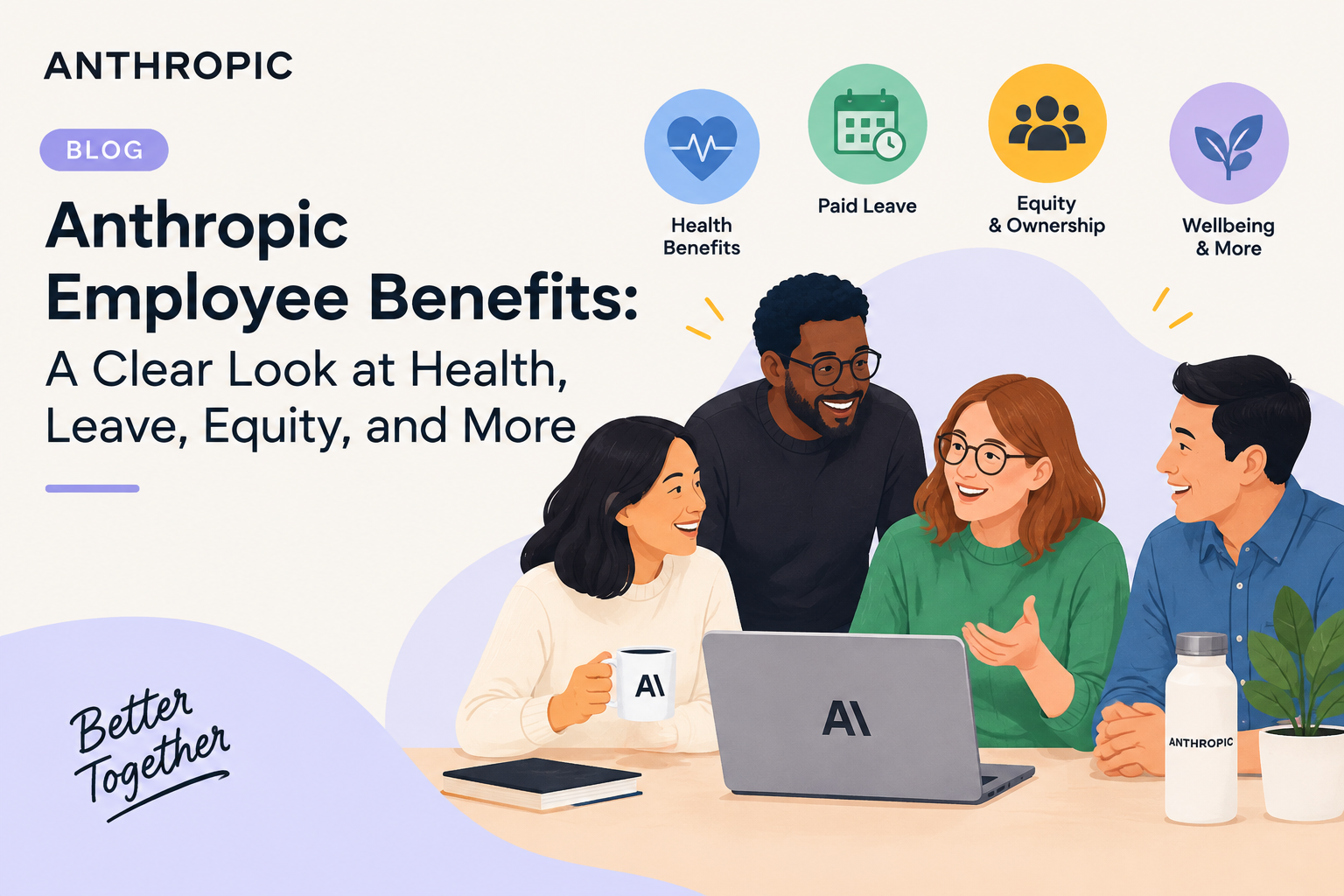
When people research anthropic employee benefits, they are usually weighing a job offer, comparing employers, or simply curious how a fast-growing AI company treats its staff. The answers are scattered across job postings, review sites, and blog roundups, and they do not always agree.
This article pulls the main pieces together in plain language. It separates what the company states in its own job listings from what third-party sites report, and it explains why the details can differ by country, role, and year.
How the Compensation Package Is Built
Anthropic’s job postings describe compensation as three elements: salary, equity, and benefits. That structure is worth keeping in mind, because anthropic employee benefits make up only one third of the picture.
For many roles, equity is described as a major part of total pay. The company says it aims to offer higher-than-average equity for a company of its size, and it shares the amounts when an offer is issued. Equity is not part of every role, so eligibility matters.
Salary ranges appear on individual postings and vary by level and location. The benefits described below sit on top of that base.
Health, Dental, and Vision Coverage
Health coverage is the most consistent theme across sources. US postings list comprehensive health, dental, and vision insurance for employees and all of their dependents. Covering dependents is a detail worth noticing, because many employers cover the employee well and then charge a lot extra for family members.
Third-party summaries add that mental health resources, life insurance, and income protection are part of the package, and one source mentions a subsidy toward a primary care membership service. Employee reviews on Glassdoor rate the health plans highly and mention that there are several plan choices in the Bay Area.
That is why most descriptions of anthropic employee benefits start with healthcare. It is the part nearly every source mentions, and it is the part that is hardest to replace if you ever leave.
Parental Leave and Family-Building Support
The headline number is 22 weeks of paid parental leave for US-based employees, according to the company’s own postings. UK postings list 21 weeks. Both figures are well above what most employers offer, and at least one analysis calls 22 weeks high-end across all kinds of companies.
Fertility benefits are also listed. In the US postings they are provided through a service called Carrot. For people planning a family, this kind of support can be worth as much as a salary increase.
The family-focused side of anthropic employee benefits is where the company stands out most clearly, at least on paper. As with any policy, read the full document before you rely on it. Check who is eligible, whether leave can be split into blocks, and how it works for adoption or other routes to parenthood.
Equity and Donation Matching
Anthropic is a private company, so its equity is not the same as shares you can sell on any given day. Third-party sources describe four-year vesting as standard, but the exact terms belong in your written offer.
One unusual perk is optional equity donation matching. Older job postings described a 3-to-1 match, up to 50 percent of an equity grant. More recent reports describe a 1-to-1 match, up to 25 percent. The difference may reflect a policy change, and it shows how quickly specifics can shift.
For readers comparing anthropic employee benefits across employers, the donation match is a rare feature. It also fits a company that talks a great deal about its mission and about giving back.
Retirement, Wellness, and Stipends
Beyond the items on official postings, third-party sites report several more perks. These include a 401(k) plan with company matching, a monthly wellness stipend, an education or learning allowance, a home office fund, commuter benefits, and daily meals at the office. One roundup mentions a 4 percent retirement match and a wellness stipend of $500 a month, while another says there are four kinds of stipends paid monthly or yearly.
These items come from review sites and blog summaries, not from the company’s careers page, so treat them as reports and not as promises. Some may apply only to certain offices or levels, and amounts change over time.
The practical lesson about anthropic employee benefits at this level of detail is to ask your recruiter directly. They can confirm what applies to your role, your location, and your start date.
Time Off and Flexibility
Company postings describe generous vacation and flexible working hours. Several third-party sources go further and describe unlimited paid time off, with one saying most staff take roughly four to six weeks a year.
Unlimited policies work differently from fixed ones. There is usually no leftover balance to be paid out when you leave, and team norms shape how much time people actually take. A policy that sounds endless can still feel limited if nobody uses it.
Work arrangements are described as hybrid, built around central office hubs, and some roles carry their own location rules. Check these before you accept.
Time off is the part of anthropic employee benefits where written policy and everyday culture matter most. One review-site analysis notes that taking leave can be a challenge in a high-intensity setting, although some reviewers say they are actively encouraged to use their time.
Benefits Outside the United States
Anthropic hires in more than one country, and the packages are written separately for each region. The UK postings, for example, list private health, dental, and vision insurance for employees and their dependents, 21 weeks of paid parental leave, a health cash plan, life insurance, and income protection, along with optional equity donation matching.
Anyone outside the US or UK should read the posting for their own country, because anthropic employee benefits are not a single global list. Rules on healthcare, leave, and retirement are shaped by local law, which means the same perk can look quite different from one country to the next.
How the Package Compares
Comparisons are tricky because every employer bundles things differently. Large public tech companies often win on stock liquidity, since their shares trade openly. Anthropic’s pitch rests more on strong health coverage, long family leave, and equity that could be worth more or less depending on how the company develops.
Seen that way, anthropic employee benefits look strongest for people who value stability for their family, such as new parents, and for people who are comfortable with the uncertainty of private-company equity.
If you prefer a larger guaranteed cash component and easy-to-sell stock, a different employer might fit better. Neither choice is wrong. It depends on your stage of life and your appetite for risk.
What Employees Say
Review-site ratings of anthropic employee benefits are glowing. One Glassdoor summary shows a 4.7 out of 5 rating for benefits and perks, and individual reviewers call the package the most generous they have seen and praise the health plans and stipends.
That rating, however, rested on only ten anonymous reviews at the time it was captured, which is a very small sample. Reviews also lean toward people who chose to write one, and they can age quickly as policies change.
Use reviews to spot themes, such as strong healthcare and family support, rather than to confirm exact numbers.
Trade-Offs Worth Weighing
No package is all upside. Equity in a private company carries real uncertainty, and its value depends on events no employee controls. A high-intensity work environment can make generous policies harder to use in practice. And big numbers in blog posts may be out of date.
When you weigh anthropic employee benefits against those trade-offs, think about which items you would truly use. A long parental leave matters enormously if you are about to have a child and very little if you are not. A rich health plan saves the most money for people with families or ongoing medical needs.
It also helps to be honest about pace. Reports of a demanding culture suggest that you should ask hiring managers how teams handle workload and time off before you say yes.
How to Verify Current Details
Start with the company’s careers page and the specific job posting you are interested in. The benefits section is region-specific and is the closest thing to an official statement.
Next, ask your recruiter to confirm details in writing, especially anything that came from a review site or a blog. Check the date on every third-party source, because some roundups were written more than a year ago.
A good test is simple. If a claim about anthropic employee benefits appears on only one site and not in an official posting, treat it as a question to ask, not as a fact to plan around.
Tips for Reading an Offer
Look at the whole picture: base salary, equity amount and vesting schedule, any bonus, leave policy, how much of the health premium is covered, and the retirement match. Then try to turn each item into a rough yearly value so you can compare offers fairly.
Putting a rough dollar figure on anthropic employee benefits helps you see their weight. A plan that covers a whole family’s insurance can save a household thousands of dollars a year, and a long paid leave replaces months of income at a time when expenses often rise.
Be cautious with equity numbers. Ask about vesting, the exercise or settlement terms, and whether there is any way to sell shares before a public listing. This article is general information and not financial advice, so consider speaking with a qualified advisor about the tax side of any equity grant.
Final Thoughts
Taken together, anthropic employee benefits describe a package built around health coverage, family support, and mission-linked equity. The company’s own postings list comprehensive insurance for dependents, 22 weeks of paid parental leave in the US, fertility support, and optional donation matching. Third-party sources add retirement matching, stipends, and flexible time off.
The details will keep changing, so treat every number here as a starting point. Read the current posting, ask questions in writing, and weigh the package against your own life. The best benefits are the ones you will actually use.
Read more trending Blogs on Zio Magazine.